Angolan Army
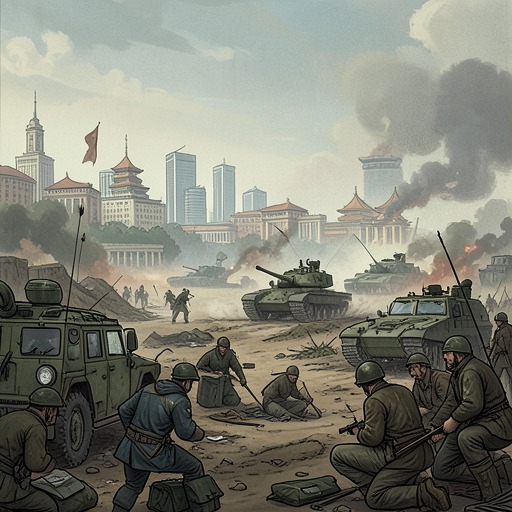
Another Day of LifeThe Angolan Army is presented as a military force taking shape amid the struggle for control of Angola, not as a fully supplied institution arriving ready for war. Its early units had to defend territory with inexperienced soldiers and scarce ammunition, while unreliable roads, vehicles, fuel, and communications constrained what commanders could do. After the creation of the People’s Republic of Angola, its leadership consolidated forces for an offensive; the subsequent counteroffensive, supported by Cuban units, shifted the balance of the war.
Formation Under Wartime Pressure
The book’s early picture of the force is that of units assembled faster than they could be trained or equipped. Comandante Ndozi had years of guerrilla experience, but the soldiers under his command were new to battle. Many had been taken from the streets, and schools had closed to provide recruits for an army formed to defend the country. The narrator sets this emergency against the cost to the young soldiers: they should have been learning to read and write, building towns, and improving public health, but instead had to learn to fight.
That transition from guerrilla experience to inexperienced troops shaped how the units behaved under fire. Soldiers who could not identify the enemy or judge the direction and distance of gunfire sometimes fired blindly, using the noise to suppress their own fear. In one encounter, a recruit aimed a bazooka into the air until Ndozi directed him toward the palms where the enemy was. The episode makes training more than a question of accuracy: a soldier had first to overcome the panic that prevented him from understanding the battle around him.
Combat, Command, and Supply
The force’s first engagements depended heavily on ammunition and on how commanders used it. In one account, a unit’s sudden volley frightened an inexperienced opposing force into retreat. But firing could also consume the means to continue: Ndozi recalled troops who spent all their ammunition at the beginning of an attack and then entered their objective with empty clips. The town had been taken, but the unit could not pursue or attack further. The difference between a successful seizure and the ability to exploit it lay in the supply of cartridges.
Other shortages made even a battlefield victory precarious. After a battle, wounded soldiers waited in a truck because its driver was waiting for gasoline before taking them to Luanda. There was no doctor on that front, and delay threatened the wounded. Ammunition was running short as well; Ndozi expected that the enemy might return the next day, when his unit would have little with which to defend the town. Commanders thus faced connected problems of casualty evacuation, fuel, and resupply, rather than a simple choice between advancing and holding ground.
The same constraints defined operations in the south. Comandante Farrusco’s unit numbered 120 and was the only unit on a vast front extending between Lubango and the border and between the Atlantic and Zambia. Its position depended on a single road; the surrounding bush offered neither reliable landmarks nor water, and the unit lacked enough transport to retreat on foot or move everyone elsewhere. On the route toward Pereira d’Eça, convoys had been lost in ambushes and none had reached the unit there for a month. A dilapidated truck carried soldiers and supplies through this exposed corridor. The danger was confirmed by wrecked vehicles and remains of lost convoys; leaving the road brought its own risk, since the bush offered no dependable water or route to safety.
Air transport partly bridged the distances that ground convoys could not. The MPLA’s only plane in Luanda was an old, patched DC-3 flown by Ruiz. He carried ammunition from Brazzaville, delivered cartridge boxes and flour to besieged towns, and brought seriously wounded soldiers back to Luanda. With no air controllers and uncertain control of landing strips, he first had to establish whether an airport remained safe; troops waiting in Luso, Novo Redondo, and Quibala depended on these flights. The aircraft’s failing condition made this supply link fragile: engine trouble could ground it, while spare parts and mechanics were unavailable.
Territorial Operations and Public Accounts
The capture of Caxito shows the units operating on the northern front. Comandante Ndozi’s unit seized the town from the FNLA, taking 120 prisoners. Comandante Ju-Ju, political commissar of the MPLA general staff, communicated the war situation in a daily radio bulletin. His accounts could describe victories in elevated, celebratory language, while setbacks prompted longer broadcasts with more praise for the MPLA and denunciation of its enemy. The contrast mattered to listeners trying to judge a fast-changing front: the length and tone of the bulletin could signal that something had gone wrong even when its wording remained optimistic.
The narrator also describes a widening gap between official confidence and military conditions. At one point, half the country was in enemy hands, yet Ju-Ju’s radio account made victory seem close. Such reassurance was intended to prevent panic, but it could also make an appeal for immediate effort seem inconsistent with the claim that the situation was already going well. The book presents morale and military communication as part of the army’s operating environment: the public account of the fighting could sustain confidence, but could also weaken trust when it obscured the scale of the danger.
Independence and the Counteroffensive
The political split within the MPLA forms part of the background to the army’s development. In April 1975, the MPLA army’s chief of staff, Daniel Chipenda, went over to the FNLA, while one of the organization’s founders, Mário de Andrade, left its directorate. In July, the MPLA drove the FNLA divisions out of Luanda, and most of Angola’s territory came under MPLA control. These changes belong to a conflict in which the military force and the political movement directing it were themselves under strain.
At independence on 11 November 1975, the People’s Republic of Angola was created under the MPLA program. The program envisaged a people’s democracy, state ownership of principal natural resources and major elements of the economy, rights to employment and education, and a policy of positive neutrality. Agostinho Neto became the republic’s first president. The book’s account of the Angolan Army at this point is still one of military vulnerability: the young republic remained in a difficult predicament, though it had a chance to defend itself, and its leadership was consolidating forces to go on the offensive.
That planned offensive followed in November, when the MPLA army began a counteroffensive supported by units of the Cuban Army. During December and January, the armies of the FNLA and UNITA were destroyed. The sequence gives the organization’s emergence its central significance: a force first shown learning to fight amid shortages and fragmented territorial control became the military instrument of a new republic and of its effort to hold power. The account does not present that change as effortless or complete; it is marked throughout by the material limits that had shaped the army from its earliest operations.